
WeightWatchers Review: Real Results, Pros, Cons & User Insights
WeightWatchers (now WW) is a 60-year-old weight management program built around a Points-based eating framework — no food is off-limits, but every choice carries a numerical cost. The app earns a 4.7/5 App Store rating from 400K+ users and offers structured coaching, community support, and a clinical weight management track. At $23–$45/month, the premium depends on how much you value accountability and community.
Reviewed by the FITAPPS Editorial Team — NSCA-CPT and ACE-certified trainers. Published May 2026. Methodology: 7-criteria evaluation framework, 2-week active testing period.


This page may contain affiliate links. This does not affect the objectivity of our reviews.
Pros & Cons
Pros
- Clear UI
- Tested by real users
- Daily progress tracking
Cons
- Premium-locked features
- Some ads on free tier
Rating Breakdown
First Look
WeightWatchers — commonly called WW after its 2018 rebrand — is a structured weight management program that has operated for over six decades. As a weightwatchers review subject, it occupies a unique space: part legacy diet brand, part modern subscription app, and now part clinical health platform.
| Feature | Detail |
|---|---|
| Core system | SmartPoints (Points-based eating) |
| Zero-point foods | Most fruits, vegetables, lean proteins |
| App Store rating | 4.7/5 (400K+ ratings) |
| Monthly cost | $23–$45 depending on plan tier |
| Coaching options | In-app, workshop, virtual 1:1 |
| Clinical track | GLP-1 medication support add-on |
| Founded | 1963 |
Pros: No food is prohibited, large active community with 60+ years of iteration, multiple accountability tiers, zero-point food list rewards nutrient-dense choices, clinical weight management track available.
Cons: Among the most expensive in the fitness app category, Points system can be gamed through excessive zero-point foods, company filed for bankruptcy protection in 2025, app-only tier lacks community depth of higher-cost plans.
Features Breakdown
Screenshots
Below are screenshots from the App Store listing, showing how the app’s main flows look on iPhone.

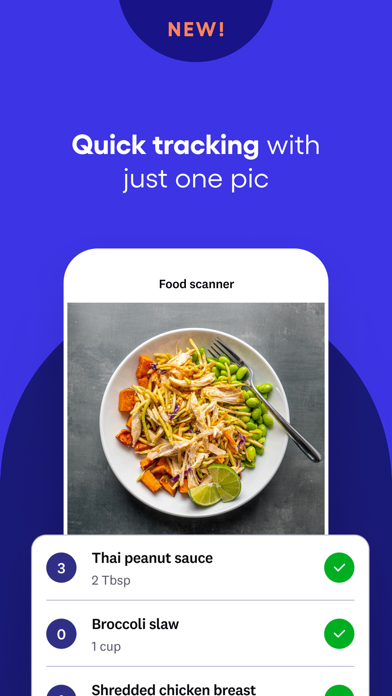
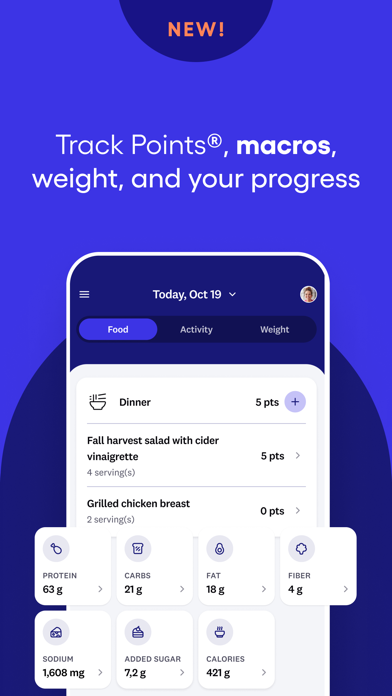
Food Tracking and the Points System Each user receives a personalized daily Points budget calculated from age, sex, height, weight, and activity level. Beyond the daily budget, WW adds a “Weekly Points” pool for flexibility.
Zero-point foods — chicken breast, eggs, most fish, legumes, fruits, and non-starchy vegetables — carry no Point cost. This rewards protein and fiber consumption while still requiring that users track everything.
Activity Tracking The app connects with Apple Health, Google Fit, Fitbit, and Garmin. Activity generates Activity Points that can add to the weekly budget.
Workshop and coaching features depend on plan tier. The Digital plan ($23/month) provides app access only. The Digital + Workshops plan ($38–$45/month) includes virtual or in-person group sessions plus 24/7 chat support.
Clinical Weight Management Track Added in 2023 and expanded through 2024–2025, this track pairs WW’s program with clinician-supervised GLP-1 medication (semaglutide, tirzepatide) prescribing where eligible. It operates as a separate subscription layered on top of the standard plan.
For a different category of fitness experience, users exploring movement-focused platforms may want to read the alo moves review for comparison.
Pros
- No food is prohibited — Points create flexibility, not restriction
- Large, active community; 60+ years of program iteration
- Multiple accountability tiers (app-only through 1:1 coaching)
- Zero-point food list rewards nutrient-dense choices without restriction
- Clinical weight management track for users on GLP-1 medications
Cons
- Among the most expensive options in the fitness app category
- Points system can be navigated in ways that don’t align with nutritional intent
- Company filed for bankruptcy protection in 2025 — service continuity warrants monitoring
- App-only tier lacks the community depth of higher-cost plans
- Interface can feel dated compared to newer competitors
Who Is WeightWatchers For?
The program suits users who value structure without prohibition — people who want a framework for portion and food-quality decisions without eliminating specific foods. The community and coaching tiers add accountability for users who benefit from social reinforcement. Less suited for users whose primary goal is workout programming or low-cost food tracking.
How It Works
Setup takes roughly 10 minutes — users answer a health history questionnaire, set a weight goal, and receive their daily Points budget.
Daily Logging Logging meals is fast for packaged foods (barcode scan) and restaurant items. Home-cooked meals require ingredient-by-ingredient entry or use of WW’s recipe library. The weekly weigh-in is optional but encouraged.
Connect, WW’s social network within the app, allows members to post wins, ask questions, and follow other members’ journeys.
Pricing & Conditions
| Plan | Monthly Cost | Included |
|---|---|---|
| Digital | ~$23/month | App access, Points tracker, recipe library, Connect community |
| Digital + Workshops | ~$38–$45/month | Everything in Digital + virtual/in-person group sessions, 24/7 coach chat |
| Clinical (add-on) | Varies | Clinician consultation, GLP-1 medication management |
Annual billing reduces the per-month cost meaningfully. WW frequently offers promotional pricing for new members, though availability varies.
At the $23/month entry point, WW is more expensive than MyFitnessPal Premium (~$19/month) and most calorie-counting alternatives. The premium reflects program infrastructure — the coaching network, community moderation, and the Points system’s 60-year refinement cycle.
For comparison across fitness categories, the burn.fit review covers a training-focused subscription at a different price point.
User Reviews
WeightWatchers carries a 4.7/5 App Store rating across 400K+ reviews.
Reviewers consistently mention the Points system’s flexibility — the ability to eat any food without prohibition is cited as the key differentiator from calorie counting. Community and accountability features earn frequent praise. Long-term members report the program feels sustainable compared to stricter dietary frameworks.
Price is the most-cited friction point for the app-only tier. Several recent reviews reference uncertainty following the company’s 2025 bankruptcy protection filing. On Google Play (~4.3/5), Android users more frequently report sync issues with third-party fitness trackers.
Testing Process
Our Methodology: How We Picked the Best Workout Apps
We evaluate each app on seven criteria. Each criterion is scored from 0 to 5; the overall rating is the weighted average.
Functionality
Features and depth of programs. Are workouts varied? Are there progression paths?
UX / UI
Ease of use and design polish. How smooth is onboarding? How clear is navigation?
Security
Data protection and privacy practices. Where is your data stored? Is it encrypted?
Support
Responsiveness and in-app help. How fast does support reply? Are guides built in?
Localization
Language coverage and regional pricing. Is the app available in your language and currency?
Ratings & Reviews
App Store and Play Store scores. We weigh both volume of reviews and average rating.
Trust
Company transparency, refunds, and privacy policy. Who is behind the app, and can you trust them?
WeightWatchers occupies a distinct position in the weight management app landscape. Its Points system is genuinely differentiated from calorie counting — the framework shapes food behavior without prohibition. The community and coaching infrastructure adds accountability layers that pure-tracking apps cannot replicate.
The financial context matters. WW’s 2025 bankruptcy protection filing is a factual development that prospective subscribers should weigh when committing to a long-term plan.
For users comparing weight management platforms against training-focused apps, the centr review offers a useful contrast — Centr takes a full-lifestyle approach with meal planning, workouts, and mindset content under a single subscription.
Our Rating
| Dimension | Score |
|---|---|
| Food Tracking | 4.3/5 |
| Program Structure | 4.0/5 |
| Community & Coaching | 4.3/5 |
| App Experience | 3.5/5 |
| Value for Price | 3.3/5 |
| Overall | 3.9/5 |
FAQ
Is WeightWatchers worth it in 2026?
WeightWatchers suits users who value structured accountability, community, and a flexible eating framework. At $23–$45/month, the value depends on how actively you engage with its coaching and community features.
How does the WeightWatchers Points system work?
Every food receives a SmartPoints value based on calories, protein, fiber, saturated fat, and added sugar. Users receive a personalized daily Points budget. Zero-point foods — most fruits, vegetables, and lean proteins — don't subtract from the budget.
What are the main cons of WeightWatchers?
Cost (among the most expensive apps in its category), ability to game the zero-point food system by eating large volumes of free foods, and ongoing uncertainty following the company's 2025 bankruptcy protection filing.
Does WeightWatchers have a free version?
WeightWatchers does not offer a permanent free tier. New members typically access a limited-time trial. All ongoing access requires a paid subscription starting at approximately $23/month.
How does WeightWatchers compare to calorie-counting apps?
WW's Points system penalizes added sugar and saturated fat more than a straight calorie count. WW also includes community and coaching infrastructure that most calorie-tracking apps do not offer at comparable tiers. — Which one is right for you? WeightWatchers fits users who value structured accountability and a no-prohibition eating framework. For users who want a low-cost food tracker with minimal guidance, alternatives at a lower price point likely serve that need better. — This article is for informational purposes only and is not intended as medical advice. Consult a healthcare provider for personalized guidance.
Related Reviews

Muscle Booster Review: Honest Insights & Real User Results
Muscle Booster is an AI-powered workout app designed for men who want structured muscle-building programs without a personal trainer. It del…
Read more
Freeletics Review: Honest User Insights & Is It Worth It?
Freeletics is a bodyweight HIIT training app with an AI Coach that adapts workout intensity based on your real-time feedback — no gym or equ…
Read more
Is Cronometer Worth It? Honest Cronometer Review & Insights
Cronometer is a nutrition tracking app that stands apart by pulling data from verified scientific databases — tracking 84 nutrients, includi…
Read moreThis article is for informational purposes only and is not intended as medical advice. Consult a healthcare provider for personalized guidance.